🍽️ Dining Philosophers & Deadlock Theory
📖 What it is
Proposed by Edsger Dijkstra in 1965, the dining philosophers problem is a classic illustration of concurrency issues: deadlock, starvation, and resource contention.
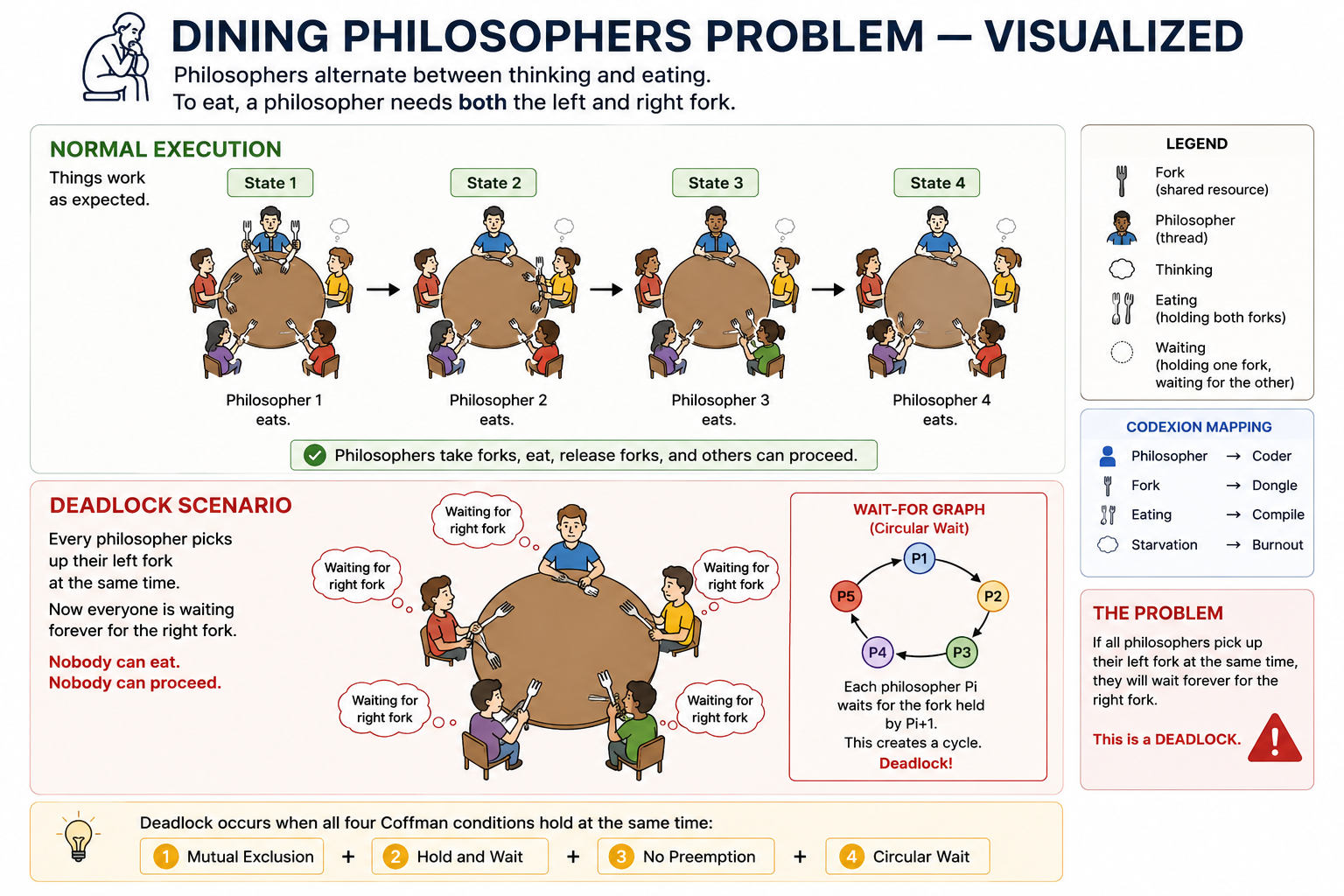
Setup: - N philosophers sit around a circular table - N forks are placed between them (one fork shared by each adjacent pair) - Each philosopher alternates between thinking and eating - Eating requires both neighboring forks (left and right) - Philosophers never communicate with each other
Codexion mapping: coder → philosopher, dongle → fork, compile → eat, burnout → starve.
⚠️ The core problem
If every philosopher picks up their left fork at the same time, all of them will be holding one fork and waiting forever for the second — nobody eats, nobody releases anything. This is a deadlock.
🔒 Coffman's 4 conditions
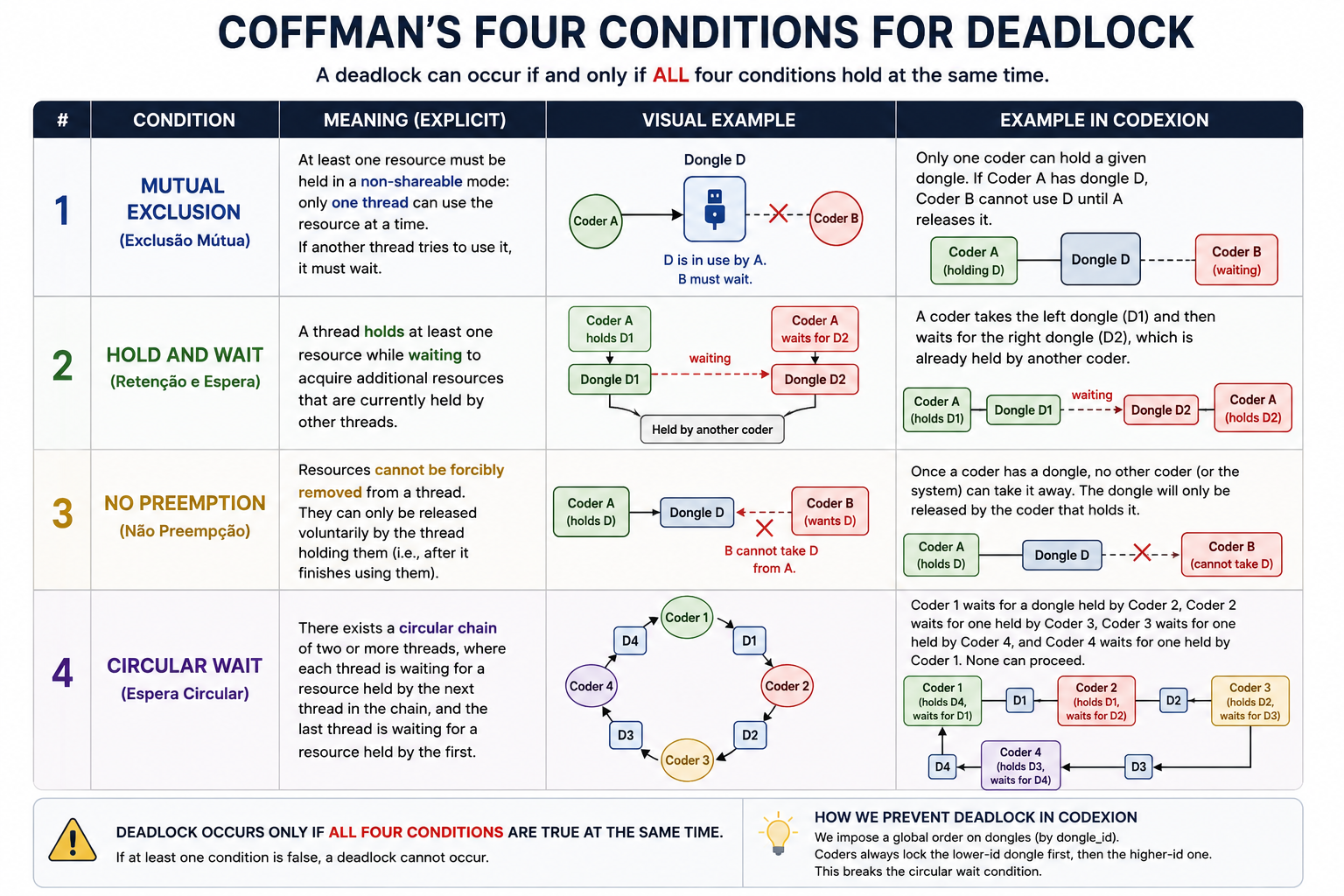
A deadlock can only occur if all four of these hold simultaneously. Breaking any one of them prevents deadlock entirely.
| # | Condition | Meaning | Example in Codexion |
|---|---|---|---|
| 1 | Mutual exclusion | A resource can only be held by one thread at a time | Only one coder can hold a given dongle |
| 2 | Hold and wait | A thread holds one resource while waiting for another | Coder holds left dongle, waits for right |
| 3 | No preemption | A resource can't be forcibly taken from a thread | Nobody can steal a dongle mid-compile |
| 4 | Circular wait | A cycle of threads each waiting on the next one's resource | Coder 1 waits on Coder 2's dongle, who waits on Coder 3's, ... back to Coder 1 |
🛠️ Classic ways to break the cycle
- Resource ordering — always acquire the lower-numbered dongle first (breaks circular wait)
- Arbitrator / waiter — a central authority grants permission to pick up both forks at once (breaks hold-and-wait)
- Odd/even asymmetry — odd-numbered philosophers pick up left-then-right, even-numbered pick up right-then-left
- Timeout + backoff — try to acquire, release and retry if the second resource isn't available (breaks hold-and-wait)
🧩 Deadlock vs Starvation vs Livelock
| Term | What happens | Analogy |
|---|---|---|
| Deadlock | Threads are stuck forever, no progress at all | Everyone frozen holding one fork |
| Starvation | Some threads make progress, but one specific thread never gets served | One philosopher always loses the race for a fork |
| Livelock | Threads keep changing state in response to each other, but no actual progress happens | Two people repeatedly stepping aside for each other in a hallway |
Codexion's burnout is essentially a starvation failure: the simulation doesn't
freeze, but one coder never gets to compile in time.
🧍 The N=1 edge case — read the subject twice here
The subject states the general rule ("N coders → N dongles, one dongle between each pair") and then adds, almost as an aside: "If there is only one coder, there should be only one dongle on the table." It's easy to read that sentence as just clarifying the topology and move on — but sit with what it implies before writing any code for this case.
Compiling always needs two dongles at once ("one in each hand"). With
exactly one dongle on the table, ask yourself: can a single coder ever satisfy
that requirement, no matter how the code is written? If the answer is no, what
should actually happen when you run the simulation with number_of_coders=1?
Does the coder loop forever without ever compiling? Does it eventually trigger
one of the two stop conditions the subject already defines? Which one, and why?
This is a case worth testing before you assume your general N-coder logic "just handles it" — a two-dongle-at-once requirement colliding with a one-dongle table is exactly the kind of edge case that's tempting to special-case away (e.g., "let the single dongle count as both") without checking whether that matches what the subject actually describes.
🔗 Why this matters for Codexion
The project explicitly requires:
- No deadlock (mutex + cond var protecting each dongle)
- No starvation under either scheduler (fifo guarantees order of arrival, edf
guarantees the most urgent coder is served first)
- Liveness proof: "no coder should be starved of dongles and burn out under edf
scheduling, provided parameters are feasible"
Understanding Coffman's conditions is what lets you argue, during defense, why your implementation can't deadlock — not just observe that it didn't in your tests.
📚 Further reading
- Dijkstra, E. W. (1971) — original synchronization papers on cooperating processes
- Silberschatz, Galvin & Gagne, Operating System Concepts — chapter on deadlocks